Non-Polio Enteroviruses in Acute Flaccid Paralysis: Analysis of Surveillance in Iraq from 2018 to 2024
DOI:
https://doi.org/10.32007/jfacmedbaghdad3246Keywords:
Acute flaccid paralysis, Demographic characteristics, Iraq, Mortality, Non-Polio Enteroviruses, Residual weakness, SurveillanceAbstract
Background: Acute flaccid paralysis surveillance, forms the basis for poliovirus eradication efforts and provides useful data on non-polio enteroviruses, which are significant causes of acute flaccid paralysis in polio-free countries. Non polio enteroviruses were the most common isolates from acute flaccid paralysis cases at this time, indicating sensitivity of surveillance and continued circulation of enteroviruses.
Objectives: This study aimed to determine the prevalence, epidemiologic trends and clinical features of non- polio enteroviruses among children with acute flaccid paralysis in Iraq, from 2018 to 2024, for improving surveillance sensitivity and complementary evidence-based public health measures.
Methods: The data was gathered from the acute flaccid paralysis surveillance system in Iraq. Stool specimens were analyzed at the National Polio Laboratory according to the World Health Organization guidelines. Suspensions of stool were prepared and inoculated into the Rhabdomyosarcoma cell line and genetically modified mouse L cells expressing the human poliovirus receptor. Isolates were subjected for real-time polymerase chain reaction, whereas cultures were checked for cytopathic effect. Isolates negative for poliovirus but positive in Rhabdomyosarcoma cells were classified as non-polio enteroviruses. Demographics and clinical findings were analyzed using appropriate statistical tests.
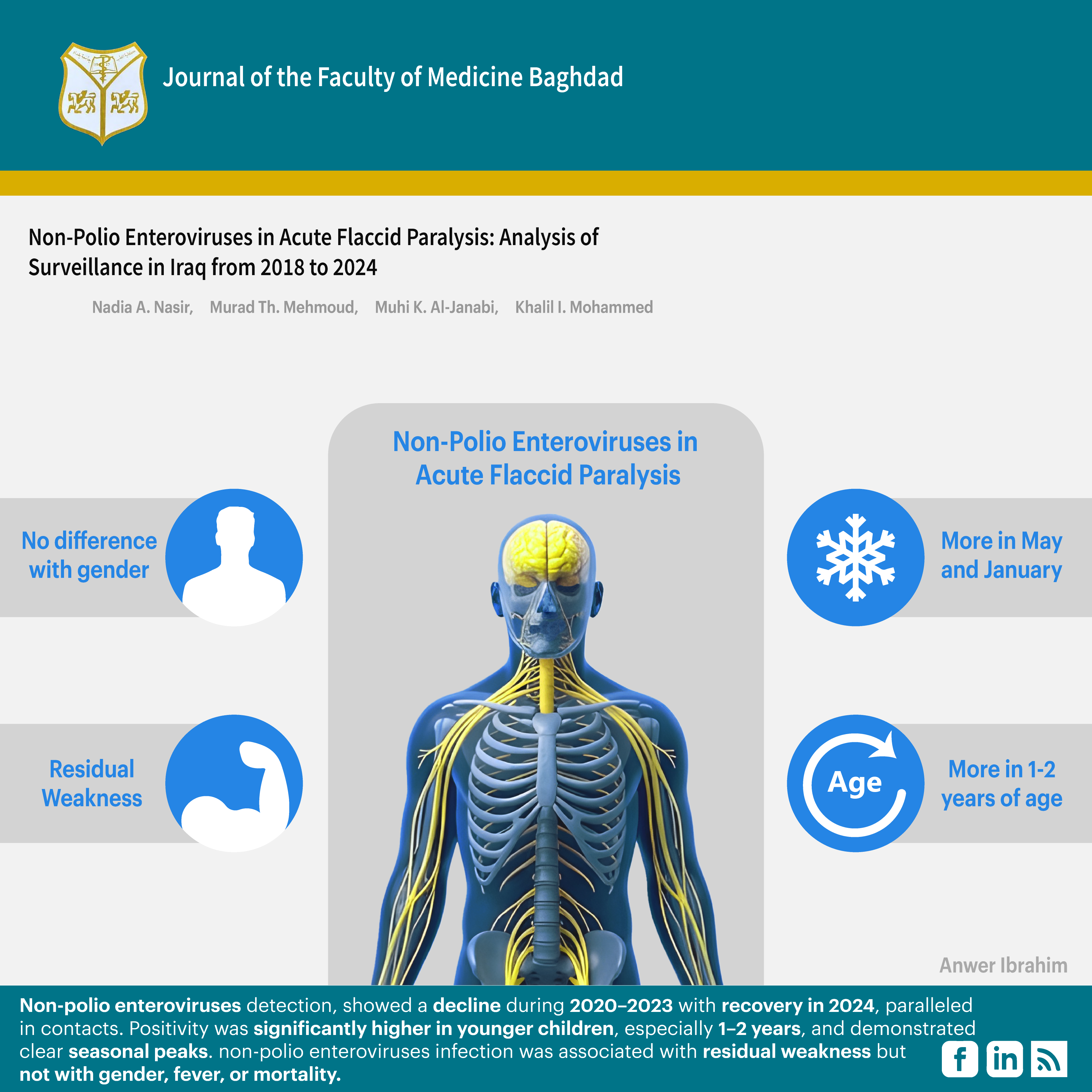
Results: Non-polio enteroviruses were reported in 10.5% of the cases; the prevalence being highest in children 1 to 2 years. They appeared to be two peaks; one in January and another in May, and cases were particularly low in September. Non-polio enteroviruses were associated with residual weakness and lower mortality.
Conclusions: Non-polio enteroviruses detection declined during 2020–2023 with recovery in 2024. Positivity was significantly higher in younger children, and demonstrated clear seasonal peaks. Non-polio enteroviruses infection was associated with residual weakness but not with gender, fever, or mortality.
Received: 28 Dec. 2025,
Revised:17 April 2026,
Accepted:24 May 2026,
Published Online: June 2026,
Published: 01 July 2026
Downloads
References
1. World Health Organization. Polio eradication strategy 2022–2026: Delivering on a promise. Geneva: WHO; 2022. https://www.who.int/publications/i/item/9789240031937.
2. Pons-Salort M, Parker EPK, Grassly NC. The epidemiology of non-polio enteroviruses: recent advances and outstanding questions. Curr Opin Infect Dis.2015;28(5):479–87. https://doi.org/10.1097/QCO.0000000000000187.
3. Tapparel C, Siegrist F, Petty TJ, et al. Picornavirus and enterovirus diversity with associated human diseases. Infection, Genetics and Evolution. 2013;14:282–293. https://doi.org/10.1016/j.meegid.2012.10.016
4. Yea C, Bitnun A, Branson HM, et al. Association of outcomes in acute flaccid myelitis with identification of enterovirus at presentation: a Canadian, nationwide, longitudinal study. Lancet Child Adolesc Health. 2020;4(11):828-36.
https://doi.org/10.1016/S2352-4642(20)30176-0
5. Ben Hamida A, Mohamed Ali K, Mdodo R, et al. Using nonpolio enterovirus detection to assess the integrity of stool specimens collected from acute flaccid paralysis cases in Somalia during 2014–2017. J Infect Dis. 2020;7(5):ofaa135.
https://doi.org/10.1093/ofid/ofaa135
6. Labropoulou S, Georgakopoulou T, Baniasadi V, et al. Surveillance of acute flaccid paralysis (AFP) in Greece: 2008–2024. Pathogens. 2025;14(10):976. https://doi.org/10.3390/pathogens14100976
7. Kissova R, Pastuchova K, Lengyelova V, et al. Surveillance program of clinical samples for polio and non-polio enteroviruses in the Slovak Republic during the 1958-2020 period. Viruses. 2022;14(9):1957. https://doi.org/10.3390/v14091957.
8. Baker RE, Yang W, Vecchi GA, et al. Increasing intensity of enterovirus outbreaks projected with climate change. Nat Commun. 2024 ;15(1):6466. https://doi.org/10.1038/s41467-024-50936-3.
9. Stehling-Ariza T, Wilkinson AL, Diop OM, et al. Surveillance to track progress toward polio eradication — worldwide, 2021–2022. MMWR Morb Mortal Wkly Rep. 2023;72(23):613-620.
https://www.cdc.gov/mmwr/volumes/72/wr/pdfs/mm7223a1-H.pdf
10. Wassilak SGF, Mohamed A, Bigouette JP. Impediments to progress toward polio eradication during 2014–2024: effectively addressing the current challenges. Vaccines (Basel). 2025;13(10):1060. https://doi.org/10.3390/vaccines13101060.
11. Hrynick TA, Ripoll Lorenzo S, Carter SE. COVID-19 response: mitigating negative impacts on other areas of health. BMJ Glob Health. 2021;6(4):e004110. http://dx.doi.org/10.1136/bmjgh-2020-004110.
12. Holm-Hansen CC, Midgley SE, Schjørring S, et al. The importance of enterovirus surveillance in a Post-polio world. Clin Microbiol Infect [Internet]. 2017;23(6):352–4. http://dx.doi.org/10.1016/j.cmi.2017.02.010.
13. Palandri L, Morgado M, Colucci ME, et al. Reorganization of active surveillance of acute flaccid paralysis (AFP) in Emilia-Romagna, Italy: A two-step public health intervention. Acta Biomed. 2020;91(3-S):85–91. https://dx.doi.org/10.23750/abm.v91i3-S.9436.
14. World Health Organization (WHO). Polio Laboratory Manual. 4th ed. Geneva: WHO; 2004. https://apps.who.int/iris/handle/10665/68762.
15. Kew OM, Sutter RW, de Gourville EM, et al. Vaccine-Derived Polioviruses and the Endgame Strategy for Global Polio Eradication. Annu Rev Microbiol. 2005;59:587-635. https://.doi.org/10.1146/annurev.micro.58.030603.123625.
16. Lassi ZS, Naseem R, Salam RA, et al. The impact of the COVID-19 pandemic on immunization campaigns and programs: A systematic review. Int J Environ Res Public Health. 2021;18(3):988. Available from: http://dx.doi.org/10.3390/ijerph18030988.
17. Progress and challenges with Achieving Universal Immunization Coverage. https://www.who.int/publications/m/item/progress-and-challenges.
18. Irwin N, Aisyah DN, Rahman FM, et al. Digital contact tracing technology in the COVID-19 pandemic: a systematic review. Health Technol (Berl). 2024. http://dx.doi.org/10.1007/s12553-024-00857-4.
19. Zomahoun DJ, Burman AL, Snider CJ, et al. Impact of COVID-19 pandemic on global poliovirus surveillance. MMWR Morb Mortal Wkly Rep. 2021;69(5152):1648-1652. https://www.cdc.gov/mmwr/volumes/69/wr/mm695152a4.htm
20. Dowdle WR, De Gourville E, Kew OM, et al. Polio eradication: the OPV paradox. Rev Med Virol. 2003;13(5):277–91. http://dx.doi.org/10.1002/rmv.401.
21. Holm-Hansen CC, Midgley SE, Fischer TK. Global emergence of enterovirus D68: a systematic review. Lancet Infect Dis. 2016;16(5):e64–75. http://dx.doi.org/10.1016/S1473-3099(15)00543-5.
22. Liu F-C, Chen B-C, Huang Y-C, et al. Epidemiological survey of Enterovirus infections in Taiwan from 2011 to 2020: Retrospective study. JMIR Public Health Surveill. 2024;10:e59449. Available from: http://dx.doi.org/10.2196/59449.
23. Nasir NA, Khalaf YH, Al-Janabi MK, et al. Non-polio Enterovirus Isolation in children with acute Flaccid Paralysis in Iraq. https://pjmhsonline.com/2020/apr-june/956.pdf.
24. Korukluoglu G, Ozdemirer U, Bayrakdar F, et al. Detection of non-polio enteroviruses in AFP surveillance in Turkey. Acta Microbiol Immunol Hung. 2021;68(2):92–98. https://doi.org/10.1556/030.2021.01353.
25. Saeed M, Zaidi SZ, Naeem A, et al. Epidemiology and clinical findings associated with enteroviral acute flaccid paralysis in Pakistan. BMC Infect Dis. 2007;7:6. https://doi.org/10.1186/1471-2334-7-6
26. Harvala H, Johannesen CK, Benschop KSM, et al. Enterovirus circulation in the WHO European region, 2015-2022: a comparison of data from WHO’s three core poliovirus surveillance systems and the European Non-Polio Enterovirus Network (ENPEN). Lancet Reg Health Eur. 2025;53(101292):101292. http://dx.doi.org/10.1016/j.lanepe.2025.101292.
27. Laxmivandana R, Yergolkar P, Gopalkrishna V, et al. Characterization of the non-polio enterovirus infections associated with acute flaccid paralysis in south-western India. PLoS ONE. 2013;8(4):e61650. https://doi.org/10.1371/journal.pone.0061650
28. Mohsin N, Asimi R. Clinical profile of acute flaccid paralysis. Arch Med Health Sci. 2016;4(2):196.
Downloads
Published
Issue
Section
Categories
License
Copyright (c) 2026 Nadia A. Nasir, Murad Th. Mehmoud, Muhi K. Al-Janabi, Khailil I. Mohammed

This work is licensed under a Creative Commons Attribution 4.0 International License.














 Creative Commons Attribution 4.0 International license..