Study of pTau217 and GFAP Levels in Iraqi Male and Female Parkinson's Patients
DOI:
https://doi.org/10.32007/jfacmedbaghdad3301Keywords:
Biomarkers, Calcium, GFAP, Parkinson’s Disease, pTau217, VitD3Abstract
Background: Parkinson's disease (PD) is a neurological condition that strikes an individual and gradually progresses, resulting in both motor and non-motor symptoms. The severity and progression of can be predicted by biochemical biomarkers, such as glial fibrillary acidic protein and degradation products, which are released into the cerebrospinal fluid and serum when astrocytes are injured. Accumulating evidence suggests that Tau protein plays a major role in the pathological mechanisms of Parkinson’s disease.
Objectives: This study aimed to evaluate the levels of Tau and human glial fibrillary acidic protein GFAP in patients with Parkinson's disease and subsequently compare them with those in the control group.
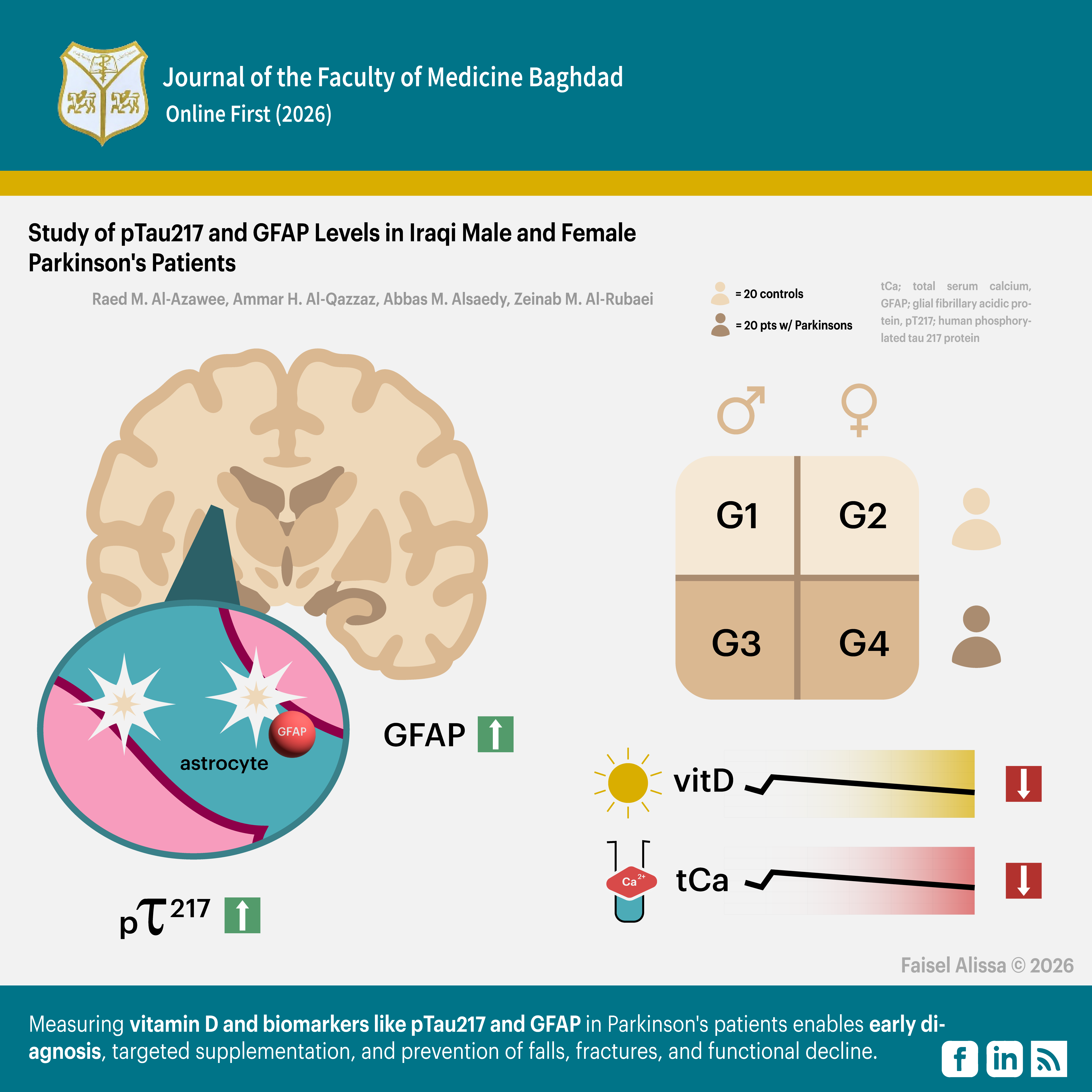
Methods: This case-control study included 80 participants. The 80 participants were divided into four categories: G1, Control Male n=20; G2, Control Female n=20; G3, Parkinson Male patients’ n=20; and G4, Parkinson Female patients’ n=20. An enzyme-linked immunosorbent assay was used to ascertain the quantities of pTau217 and GFAP. Total calcium was measured.
Results: Results showed a significant decrease in 25-hydroxyvitamin D in the patient groups compared to the control groups. In addition, G3 showed a significant decrease compared to G1. G4 showed a significant decrease compared to G2. The results also showed a significant decrease in total calcium levels in G3 compared to G1, while a non-significant decrease was found in G4 compared to G2. Results showed a significant increase in pTau217 and GFAP in G3 and G4 compared to G1 and G2.
Conclusions: Determining vitamin D levels in patients with Parkinson’s disease is important because deficiency is common and may worsen bone health, muscle strength, balance, and overall function. Testing allows appropriate supplementation and prevention of complications, particularly falls and fractures. The pTau217 and GFAP biomarkers could open new prospects for early diagnosis, monitoring the course of the disease, and personalized treatment strategies.
Received: 24 Feb. 2026,
Revised:08 May 2026,
Accepted:10 June 2026,
Published Online:20 June 2026,
Published: 01 July 2026
Downloads
References
1. Global Burden of Disease Collaborators. Global, regional, and national burden of neurological disorders, 1990–2016: a systematic analysis for the Global Burden of Disease Study 2016. Lancet Neurol. 2019;18(5):459-480. https://doi.org/10.1016/S1474-4422(18)30499-X.
2. Munhoz RP, Tumas V, Pedroso JL, et al. The clinical diagnosis of Parkinson's disease. Arquivos de neuro-psiquiatria. 2024 Jun;82(06):001-10. https://doi.org/10.1055/s-0043-1777775.
3. van der Gaag BL, Deshayes NA, Breve JJ, et al. Distinct tau and alpha-synuclein molecular signatures in Alzheimer’s disease with and without Lewy bodies and Parkinson’s disease with dementia. Acta Neuropathologica. 2024 Jun;147(1):14. https://doi.org/10.1007/s00401-023-02657-y.
4. Che N, Ou R, Li C, Zhang L, et al. Plasma GFAP as a prognostic biomarker of motor subtype in early Parkinson’s disease. Parkinson's Disease. 2024 Mar 1;10(1):48. https://doi.org/10.1038/s41531-024-00664-8.
5. Kim KY, Shin KY, Chang KA. GFAP as a potential biomarker for Alzheimer’s disease: a systematic review and meta-analysis. Cells. 2023 May 4;12(9):1309. https://doi.org/10.3390/cells12091309.
6. Youssef P, Hughes L, Kim WS, et al. Evaluation of plasma levels of NFL, GFAP, UCHL1 and tau as Parkinson's disease biomarkers using multiplexed single molecule counting. Scientific Re. 2023 Mar 30;13(1):5217. https://doi.org/10.1038/s41598-023-32480-0.
7. Wang J, Zhao J, Zhao K, et al. The role of calcium and iron homeostasis in Parkinson’s disease. Brain Sci. 2024 Jan 17;14(1):88. https://doi.org/10.3390/brainsci14010088.
8. Giustina A, Bilezikian JP. Extra-skeletal effects of vitamin D. Vitamin D in Clinical Medicine. 2018 Mar 29; 50:72-88. https://doi.org/10.1159/000486072.
9. de Klerk GW, van Laar T, Meles SK. A retrospective study of the MDS criteria for prodromal Parkinson’s disease in the general population. npj Parkinson's Disease. 2024 Jun 26;10(1):125. https://doi.org/10.1038/s41531-024-00739-6.
10. Soliman RH, Oraby MI, Hussein M, et al. Could vitamin D deficiency have an impact on motor and cognitive function in Parkinson’s disease?. Egypt. J. Neurol. Psychiatry Neurosurg. 2019 May 29;55(1):34. https://doi.org/10.1186/s41983-019-0084-9.
11. Suttrup I, Warnecke T. Dysphagia in Parkinson’s disease. Dysphagia. 2016 Feb;31(1):24-32. https://doi.org/10.1007/s00455-015-9671-9.
12. Man VH, He X, Han F, et al. Phosphorylation at Ser289 enhances the oligomerization of Tau repeat R2. JCIM. 2023 Feb 14;63(4):1351-61. https://doi.org/10.1021/acs.jcim.2c01597.
13. Zhang H, Wei W, Zhao M, et al. Interaction between Aβ and tau in the pathogenesis of Alzheimer's disease. Int. J. Biol. Sci. 2021 May 27;17(9):2181. https://doi.org/10.7150/ijbs.57078.
14. Jack Jr CR, Wiste HJ, Algeciras-Schimnich A, et al. Predicting Amyloid PET and tau PET stages with plasma biomarkers. Brain. 2023 May 2;146(5):2029-44. https://doi.org/10.1093/brain/awad042.
15. Woo MS, Tissot C, Lantero‐Rodriguez J, et al. Plasma pTau‐217 and N‐terminal tau (NTA) enhance sensitivity to identify tau PET positivity in amyloid‐β positive individuals. Alzheimer's & Dementia. 2024 Feb;20(2):1166-74. https://doi.org/10.1002/alz.13528
16. Blommer J, Pitcher T, Mustapic M, et al. Extracellular vesicle biomarkers for cognitive impairment in Parkinson’s disease. Brain. 2023 Jan 4;146(1):195-208. https://doi.org/10.1093/brain/awac258.
17. Ren J, Pan C, Wang Y, et al. Plasma α‐synuclein and phosphorylated tau 181 as a diagnostic biomarker panel for de novo Parkinson’s disease. J Neurochem. 2022 Jun;161(6):506-15. https://doi.org/10.1111/jnc.15601.
18. Pilotto A, Parigi M, Bonzi G, et al. Differences between plasma and cerebrospinal fluid p-tau181 and p-tau231 in early Alzheimer’s disease. JAD. 2022 May 31;87(3):991-7. https://doi.org/10.3233/JAD-215646.
19. Chiu PY, Yang FC, Chiu MJ, et al. Relevance of plasma biomarkers to pathologies in Alzheimer’s disease, Parkinson’s disease and frontotemporal dementia. Scientific Rep. 2022 Oct 26;12(1):17919. https://doi.org/10.1038/s41598-022-22647-6.
20. Gonzalez MC, Ashton NJ, Gomes BF, et al. Association of plasma p-tau181 and p-tau231 concentrations with cognitive decline in patients with probable dementia with Lewy bodies. JAMA neurology. 2022 Jan;79(1):32-7. https://doi.org/10.1001/jamaneurol.2021.4222
21. Chouliaras L, Thomas A, Malpetti M, et al. Differential levels of plasma biomarkers of neurodegeneration in Lewy body dementia, Alzheimer’s disease, frontotemporal dementia and progressive supranuclear palsy. J Neurol Neurosurg Psychiatry. 2022 Jun 1;93(6):651-8. https://doi.org/10.1136/jnnp-2021-327788.
22. Abdelhak A, Foschi M, Abu-Rumeileh S, et al. Blood GFAP as an emerging biomarker in brain and spinal cord disorders. Nat. Rev. Neurol. 2022 Mar;18(3):158-72. https://doi.org/10.1038/s41582-021-00616-3.
23. Arya R, Haque AA, Shakya H, et al. Parkinson’s disease: biomarkers for diagnosis and disease progression. Int J Mol Sci. 2024 Nov 18;25(22):12379.https://doi.org/10.3390/ijms252212379.
24. Tang Y, Han L, Li S, et al Plasma GFAP in Parkinson’s disease with cognitive impairment and its potential to predict conversion to dementia. npj Parkinson's Disease. 2023 Feb 9;9(1):23. https://doi.org/10.1038/s41531-023-00447-7.
25. Mao S, Teng X, Li Z, et al. Association of serum neurofilament light chain and glial fibrillary acidic protein levels with cognitive decline in Parkinson’s disease. Brain Res. 2023 Apr 15; 1805:148271. https://doi.org/10.1016/j.brainres.2023.148271.
26. Teng X, Mao S, Wu H, et al. The relationship between serum neurofilament light chain and glial fibrillary acidic protein with the REM sleep behavior disorder subtype of Parkinson's disease. J Neurochem. 2023 Apr;165(2):268-76. https://doi.org/10.1111/jnc.15780 .
Downloads
Published
Issue
Section
Categories
License
Copyright (c) 2026 Raed M. Al-Azawee, Ammar H. Al-Qazzaz , Abbas M. Alsaedy , Zeinab M. Al-Rubaei

This work is licensed under a Creative Commons Attribution 4.0 International License.














 Creative Commons Attribution 4.0 International license..