Evaluation of Serum Interleukin-19 level in Women with Polyendocrine Metabolic Ovarian Syndrome
DOI:
https://doi.org/10.32007/jfacmedbaghdad3321الكلمات المفتاحية:
BMI، FSH، Luteinizing hormone (LH)، IL-19، Polyendocrine Metabolic Ovarian Syndrome (PMOS)الملخص
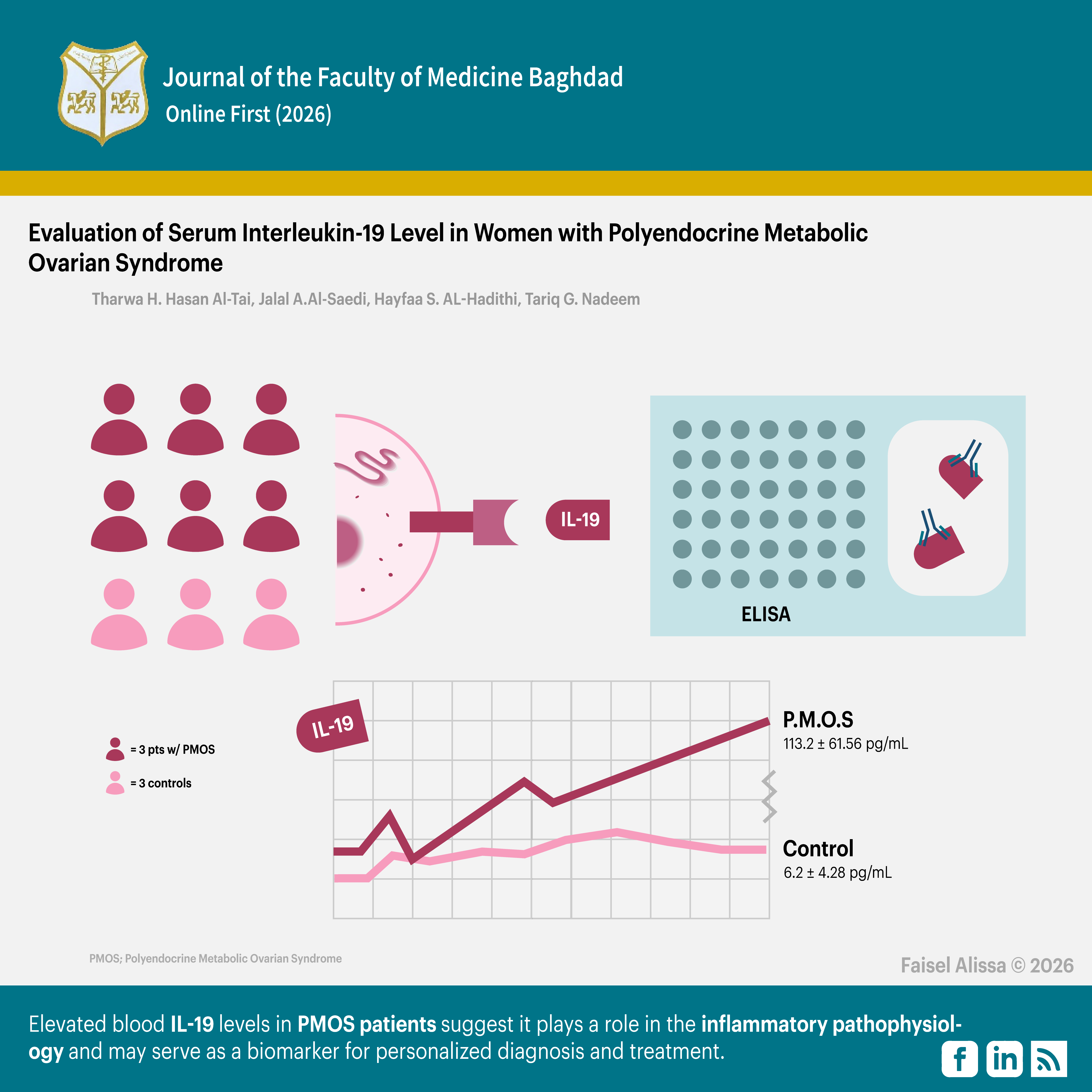
Background: Polyendocrine Metabolic Ovarian Syndrome (PMOS) typically affects women aged 15 to 50. According to recent studies, immune cells and hormonal imbalances have a role in the pathogenesis of PMOS. The causes and effects of chronic inflammation, particularly in women with PMOS, have been the focus of research.
Objectives: To better understand the immunological profile of PMOS patients through investigating the role of IL-19 blood levels as a biomarker or inflammatory mediator and examining its possible involvement in the pathophysiology of the syndrome.
Cases and Methods: This is a case-control study conducted between December 2024 and March 2025. Sixty women with PMOS were diagnosed at Kamal Al-Samarrai Specialized Hospital in Baghdad, Iraq. 30 healthy women attending private laboratories were used as a control group, matched for age (18-36) to the cases. The blood samples were centrifuged and allowed to clot at room temperature. The serum was then obtained using the enzyme-linked immunosorbent test (ELISA) for use in the human IL-19 detection method.
Results: The mean age was 26.0±4.90 years for the patients and 25.3±4.45 years for the controls. The mean Body Mass Index (BMI) of the control group was 21.9±2.01 kg/m² compared to 28.9±3.62 kg/m² for the patients in PMOS women; the mean serum IL-19 was 113.2±61.56 pg/ml, significantly higher than that of the control group (6.2±4.28 pg/ml).
Conclusion: The inflammatory environment of PMOS seems to be significantly influenced by interleukin-19. The higher blood IL-19 levels in the PMOS cases suggest that it may have a role in the pathophysiology of the syndrome, potentially connected to follicular dysfunction and insulin resistance. IL-19 may be a potential biomarker for tracking the persistent low-grade inflammation linked to PMOS, providing fresh perspectives on tailored diagnostic and treatment approaches.
التنزيلات
المراجع
1. Zhang J, Zhu Y, Wang J, et al. Global burden and epidemiological prediction of polycystic ovary syndrome from 1990 to 2019: a systematic analysis from the Global Burden of Disease Study 2019. PloS one. 2024;19(7):e0306991. https://doi.org/10.1371/journal.pone.0306991.
2. Teede HJ, Khomami MB, Morman R,et al. Polyendocrine metabolic ovarian syndrome, the new name for polycystic ovary syndrome: a multistep global consensus process. The Lancet. 2026;407(10545):2329-2339.
https://doi.org/10.1016/S01406736(26)00717-8
3. Wang J, Yin T, Liu S. Dysregulation of immune response in PCOS organ system. Front Immunol. 2023;14:1169232.
https://doi.org/10.3389/fimmu.2023.1169232.
4. Khashchenko E, Vysokikh M, Uvarova E, et al. Activation of systemic inflammation and oxidative stress in adolescent girls with polycystic ovary syndrome in combination with metabolic disorders and excessive body weight. Journal of Clinical Medicine. 2020; 9(5): 1399. https://doi.org/10.3390/jcm9051399.
5. Al-Taei OMS and Al-Harmooshee MBH. Genetic polymorphisms and immune cytokine profiles in the cellular pathogenesis of polycystic ovary syndrome among Iraqi women. Cellular and Molecular Biology.2025; 71(9), 56-62. https://doi.org/10.14715/cmb/2025.71.9.7.
6. Rudnicka E, Suchta K, Grymowicz M, et al. Chronic Low-Grade Inflammation in Pathogenesis of PCOS. Int J Mol Sci. 2021;22(7):3789. https://doi.org/10.3390/ijms22073789.
7. Vasyukova E, Zaikova E, Kalinina O, et al. Inflammatory and Anti-Inflammatory Parameters in PCOS Patients Depending on Body Mass Index: A Case-Control Study. Biomedicines. 2023;11(10):2791. https://doi.org/10.3390/biomedicines11102791.
8. Singh S, Pal N, Shubham S, et al.et al.. Polycystic ovary syndrome: etiology, current management, and future therapeutics. Journal of clinical medicine. 2023; 12(4):1454. https://doi.org/10.3390/jcm12041454.
9. Akpang N, Kwiatkowski J, Zaborowska L, et al. Autoantibodies targeting the hypothalamic-pituitary-ovarian axis in polycystic ovary syndrome: emerging key players in pathogenesis?. International Journal of Molecular Sciences. 2025; 26(9): 4121. https://doi.org/10.3390/ijms26094121.
10. Pratama G, Wiweko B, Asmarinah, et al. Mechanism of elevated LH/FSH ratio in lean PCOS revisited: a path analysis. Scientific reports. 2024; 14(1): 8229. https://doi.org/10.1038/s41598-024-58064-0.
11. Zheng L, Yang L, Guo Z, et al. Obesity and its impact on female reproductive health: unraveling the connections. Frontiers in endocrinology.2024; 14,1326546. https://doi.org/10.3389/fendo.2023.1326546.
12. Daghestani MH, Daghestani MH, Warsy A, et al. Adverse effects of selected markers on the metabolic and endocrine profiles of obese women with and without PCOS. Frontiers in endocrinology. 2021;12:665446. https://doi.org/10.3389/fendo.2021.665446.
13. Kyrou I, Karteris E, Robbins T, et al. Polycystic ovary syndrome (PCOS) and COVID-19: an overlooked female patient population at potentially higher risk during the COVID-19 pandemic. BMC Medicine. 2020; 18:220. https://doi.org/10.1186/s12916-020-01697-5.
14. Gao J, Mai Q, Zhong Y, et al. Pretreatment with oral contraceptive pills in women with PCOS scheduled for IVF: a randomized clinical trial. Human Reproduction Open. 2024; 2024(2): hoae019. https://doi.org/10.1093/hropen/hoae019.
15. Calcaterra V, Verduci E, Cena H, et al. Polycystic Ovary Syndrome in Insulin-Resistant Adolescents with Obesity: The Role of Nutrition Therapy and Food Supplements as a Strategy to Protect Fertility. Nutrients. 2021; 13(6):1848. https://doi.org/10.3390/nu13061848.
16. Zeitler FS and Nadeau KJ. Insulin Resistance: Childhood Precursors and Adult Disease e-book. USA, Totowa(NJ): Humana Press;2020. p.356. https://doi.org/10.1007/978-3-030-25057-7.
17. Rayi MM, Monteiro RC, Ramachandrayya S. Role of serum interleukin-19 (IL-19) levels in acne vulgaris: a comprehensive case control study. Archives of Dermatological Research. 2025; 317(1): 759.
https://doi.org/10.1007/s00403-025-04263-2.
18. Mohammed HM, Qurtas DS, Meran AD. Serum interleukin-19 levels in acne vulgaris patients of varying clinical severity in Erbil City. Cureus. 2023;15(11). https://doi.org/10.7759/cureus.48939.
19.Azuma YT, Nakajima H, Takeuchi T. IL-19 as a potential therapeutic in autoimmune and inflammatory diseases. Curr Pharm Des. 2011;17(34):3776-80. https://doi.org/10.2174/138161211798357845.
20.Leigh T, Scalia RG, Autieri MV. Resolution of inflammation in immune and nonimmune cells by interleukin-19.Am J Physiol Cell Physiol. 2020 ;319(3):C457-C464. https://doi.org/10.1152/ajpcell.00247.2020
21. Al-Musawy SH, Al-Saimary IE, Flaifil MS. Levels of cytokines profile in polycystic ovary syndrome. Medical Journal of Babylon. 2018 Apr 1;15(2):124-8. https://doi.org/10.4103/mjbl.mjbl_32_18.
22. Rudnicka E, Kunicki M, Suchta K, et al. Inflammatory Markers in Women with Polycystic Ovary Syndrome. Biomed Res Int. 2020 4;2020:4092470. https://doi.org/10.1155/2020/4092470.
23. Papalou O, Livadas S, Karachalios A, et al. White blood cells levels and PCOS: direct and indirect relationship with obesity and insulin resistance, but not with hyperandogenemia. Hormones (Athens). 2015;14(1):91-100. https://doi.org/10.14310/horm.2002.1563.
24. Liu S, Hong L, Lian R, et al. Transcriptomic analysis reveals endometrial dynamics in normoweight and overweight/obese polycystic ovary syndrome women. Frontiers in Genetics.2022;13:874-887. https://doi.org/10.3389/fgene.2022.874487.
25. Esteves SC and Alviggi C. The role of LH in controlled ovarian stimulation. In: Ghumman S, editor. Principles and practice of controlled ovarian stimulation in ART. New Delhi: Springer;2015. p.171-96.
https://doi.org/10.1007/978-81-322-1686-5_16.
26. Khan D and Ansar AS. The immune system is a natural target for estrogen action: Opposing effects of estrogen in two prototypical autoimmune diseases. Front Immunol 2016; 6:635. https://doi.org/10.3389/fimmu.2015.00635.
27. Papaetis GS, Sacharidou A, Michaelides IC, et al. Insulin resistance, hyperinsulinemia and atherosclerosis: insights into pathophysiological aspects and future therapeutic prospects. Current cardiology reviews. 2025;21(1):E1573403X314035. https://doi.org/%20%2010.2174/011573403X314035241006185109
28. Houston EJ and Templeman NM. Reappraising the relationship between hyperinsulinemia and insulin resistance in PCOS. Journal of Endocrinology. 2025; 265(2). https://doi.org/10.1530/JOE-24-0269.
29. Meczekalski B, Niwczyk O, Kostrzak A, et al. PCOS in Adolescents ongoing riddles in diagnosis and treatment. Journal of clinical medicine.2023; 12(3): 1221. https://doi.org/10.3390/jcm12031221.
30. Parker J, Briden L, Gersh FL. Recognizing the Role of Insulin Resistance in Polycystic Ovary Syndrome: A Paradigm Shift from a Glucose-Centric Approach to an Insulin-Centric Model. Journal of Clinical Medicine. 2025; 14(12):4021. https://doi.org/10.3390/jcm14124021.
31. Tehrani FR and Amiri M. Polycystic ovary syndrome in adolescents: challenges in diagnosis and treatment. International journal of endocrinology and metabolism. 2019; 17(3): e91554. https://doi.org/10.5812/ijem.91554.
32. Carreau AM and Baillargeon JP. PCOS in Adolescence and Type 2 Diabetes. Curr. Diab. Rep. 2015; 15(1): 564.
https://doi.org/10.1007/s11892-014-0564-3.
33. Ahmed RS, Aljabar FA, Al-Shakir NM. Impact of Insulin Resistance in PCOS (LH/FSH) in a Group of Woman in Baghdad City. Al-Esraa University College Journal for Medical Sciences. 2025; 6(9):20-30.
https://doi.org/10.70080/2790-7937.1045.
34.Gholinezhad M, Gholsorkhtabaramiri M, Esmaeilzadeh S, et al. Insulin resistance and adverse metabolic profile in overweight/obese and normal-weight young women with polycystic ovary syndrome. Caspian J Intern Med. 2018; 9(3): 260-267. https://doi.org/10.22088/cjim.9.3.260.
35. Al-Jefout M, Alnawaiseh N, Al-Qtaitat A. Insulin resistance and obesity among infertile women with different polycystic ovary syndrome phenotypes. Scientific reports. 2017; 7(1):5339. https://doi.org/10.1038/s41598-017-05717-y.
36. Urbano F, Chiarito M, Lattanzio C, et al. Sex hormone-binding globulin (SHBG) reduction: the alarm bell for the risk of non-alcoholic fatty liver disease in adolescents with polycystic ovary syndrome. Children. 2022; 9(11):1748. https://doi.org/10.3390/children9111748.
37. Esam D, Abdel-Moneim A, Mahmoud B, et al. Role of nuclear factor kappa B, interleukin-19, interleukin-34, and interleukin-37 expression in diabetic nephropathy. Beni-Suef University Journal of Basic and Applied Sciences. 2022; 11(1), 119. https://doi.org/10.1186/s43088-022-00299-9.
38. Azuma YT and Nishiyama K. Interleukin-19 enhances cytokine production induced by lipopolysaccharide and inhibits cytokine production induced by polyI:C in BALB/c mice. J Vet Med Sci. 2020;82(7):891-896. https://doi.org/10.1292/jvms.20-013.
التنزيلات
منشور
إصدار
القسم
الفئات
الرخصة
الحقوق الفكرية (c) 2026 Tharwa H. Al-Tai, Jalal A. Al-Saedi, Hayfaa S. AL-Hadithi, Tariq G. Nadeem

هذا العمل مرخص بموجب Creative Commons Attribution 4.0 International License.








 Creative Commons Attribution 4.0 International license..