Effectiveness of Uterine Artery Embolization in the Management of Symptomatic Patients with Uterine Fibroids at the Medical City in Baghdad
DOI:
https://doi.org/10.32007/jfacmedbaghdad3296الكلمات المفتاحية:
العلاج؛ غزارة الطمث؛ انصمام الشريان الرحمي؛ الأورام الليفية الرحمية؛ النساء.الملخص
Background: Uterine fibroids are a common gynecological condition that may cause heavy menstrual bleeding, pelvic pain, and pressure on the nearby organs. Uterine artery embolization is a minimally invasive treatment that offers an alternative to myomectomy or hysterectomy. The procedure works by occluding the uterine arteries and reducing blood flow to the fibroids, which leads to ischemia and gradual shrinkage, thereby relieving the symptoms.
Objectives: To evaluate the effectiveness of uterine artery embolization in reducing the size of the uterine fibroids and alleviating the associated symptoms, and to compare treatment outcomes between International Federation of Gynaecology and Obstetrics FIGO 0–3 and 4–7 groups according to the FIGO classifications of uterine fibroids.
Methods: This prospective comparative study, conducted at the Baghdad Teaching Hospital from December 4, 2023, to December 22, 2024, involved 20 patients with symptomatic uterine fibroids who underwent uterine artery embolization. Ultrasounds were performed prior to, and three months and six months after the procedure, to evaluate the fibroid volume, the largest fibroid diameter, volume reduction rate, symptom improvement, and adverse events. The volume reduction rates of the two groups were compared, based on the fibroid classification (Group A: FIGO 0-3 and Group B: FIGO 4-7) at three and six months.
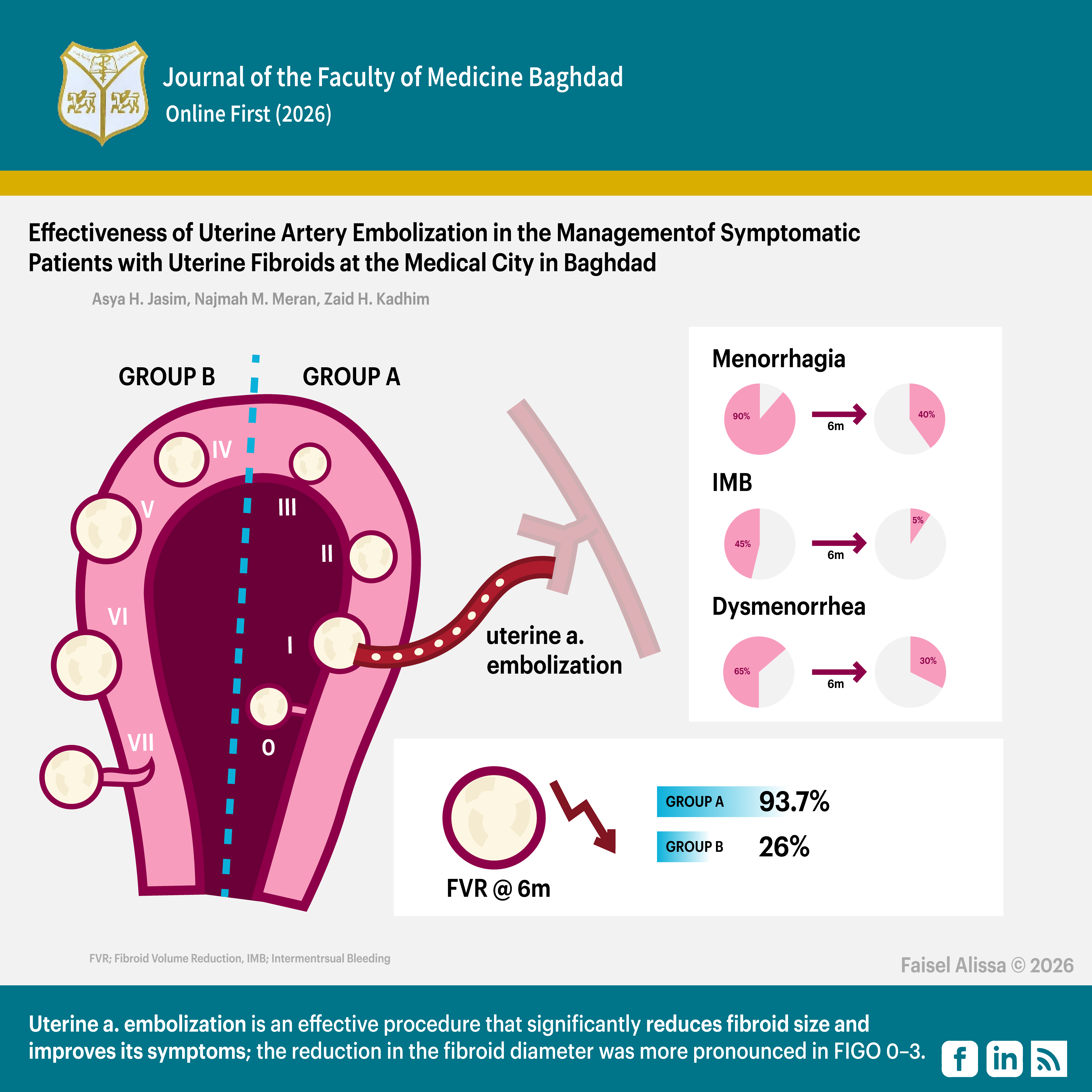
Results: Of the 20 women included in the study, 90% were over the age of 35 years and 65% were obese. Following uterine artery embolization, menorrhagia decreased from 90% to 40%, intermenstrual bleeding from 45% to 5%, and dysmenorrhea from 65% to 30%. Radiologically, the mean fibroid volume reduction at six months was significantly higher in the FIGO 0–3 group (93.7%, p=0.006) compared to the FIGO 4–7 group (26.0%, p=0.002).
Conclusions: Uterine artery embolization is an effective procedure that significantly reduces fibroid size and improves its symptoms; the reduction in the largest fibroid diameter was more pronounced in the FIGO 0–3 group than in the FIGO 4–7 group.
التنزيلات
المراجع
1. Van den Bosch T. Benign Disease of the Uterus. In: Edmonds K, editor. Dewhurst’s Textbook of Obstetrics & Gynaecology. 9th ed. Oxford, UK: Wiley-Blackwell; 2018. 826–841. https://doi.org/10.1002/9781119211457.ch59
2. Hoffman BL, Schorge JO, Halvorson LM, et al. Benign Uterine Pathology. In: Williams Gynecology. 4th ed. New York, NY: McGraw-Hill Education; 2020. 410-445. https://obgyn.mhmedical.com/book.aspx?bookid=2658&utm_source
3. Baird DD, Patchel SA, Saldana TM, et al. Uterine fibroid incidence and growth in an ultrasound-based, prospective study of young African Americans. Am J Obstet Gynecol. 2020;223(3):402.e1-402.e18. https://doi.org/10.1016/j.ajog.2020.02.016
4. Stewart EA, Nowak RA. Uterine fibroids: hiding in plain sight. Physiology (Bethesda). 2022 Jan 1;37(1):16-27. https://doi.org/10.1152/physiol.00013.2021
5. Kröncke T. An update on uterine artery embolization for uterine leiomyomata and adenomyosis of the uterus. Br J Radiol. 2023;96(1143):20220121. https://doi.org/10.1259/bjr.20220121
6. Yoon JK, Han K, Kim MD, et al. Five-year clinical outcomes of uterine artery embolization for symptomatic leiomyomas: An analysis of risk factors for reintervention. Eur J Radiol. 2018;109:83–87. https://doi.org/10.1016/j.ejrad.2018.10.017
7. American College of Obstetricians and Gynecologists. Management of symptomatic uterine leiomyomas: ACOG Practice Bulletin, Number 228. Obstet Gynecol. 2021 Jun 1;137(6):e100-e115 https://doi.org/10.1097/aog.0000000000004401
8. Wilson LF, Moss KM, Doust J, et al. First Australian estimates of incidence and prevalence of uterine fibroids: a data linkage cohort study 2000–2022. Hum Reprod. 2024;39(9):2134–43. https://doi.org/10.1093/humrep/deae162.
9. De La Cruz MSD, Buchanan EM. Uterine Fibroids: Diagnosis and Treatment. Am Fam Physician. 2017;95(2):100–107. Available from: https://www.aafp.org/pubs/afp/issues/2017/0115/p100.pdf
10. Harris HR, Petrick JL, Rosenberg L. The epidemiology of uterine fibroids: Where do we go from here? Fertil. Steril. 2022;117(4):841–2. https://doi.org/10.1016/j.fertnstert.2022.01.037.
11. Wang RL, Fu QT, Jiang J, et al. Clinical outcomes of uterine artery embolization and experience of postoperative transvaginal fibroid expulsion: a retrospective analysis. Arch Gynecol Obstet. 2022; 306(3): 829–840. https://doi.org/10.1007/s00404-022-06407-5
12. Petrozza JC. Uterine Fibroids. 1st ed. Boca Raton, FL: CRC Press; 2020. https://doi.org/10.1201/9780429155734
13. Latif F, John A, Ali A, et al. Frequency of uterine leiomyomas in multipara women: frequency of uterine leiomyomas in multipara women. Pakistan J Heal Sci. 2022; 3(1): 51–54. https://doi.org/10.54393/pjhs.v3i01.55.
14. Pavone D, Clemenza S, Sorbi F, et al. Epidemiology and Risk Factors of Uterine Fibroids. Best Pract Res Clin Obstet Gynaecol. 2018;46:3–11. https://doi.org/10.1016/j.bpobgyn.2017.09.004.
15. Kurban LAS, Metwally H, Abdullah M, et al. Uterine Artery Embolization of Uterine Leiomyomas: Predictive MRI Features of Volumetric Response. AJR Am J Roentgenol. 2021;216(4):967–74. https://doi.org/10.2214/AJR.20.22906.
16. Laughlin-Tommaso SK, Gorny KR, Hesley GK, et al. Uterine and Fibroid Imaging Analysis from the FIRSTT Study. J Womens Health (Larchmt). 2022;31(4):546-554. https://doi.org/10.1089/jwh.2020.8892.
17. Ulin M, Ali M, Chaudhry ZT, et al. Uterine fibroids in menopause and perimenopause. Menopause. 2020;27(2):238–42. https://doi.org/10.1097/GME.0000000000001438.
18. Qin H, Lin Z, Vásquez E, et al. Association between obesity and the risk of uterine fibroids: a systematic review and meta-analysis. J Epidemiol Community Health. 2021;75(2):197–204. https://doi.org/10.1136/jech-2019-213364
19. Ibrar F, Riaz S, Dawood NS, et al. Frequency of fibroid uterus in multipara women in a tertiary care centre in Rawalpindi. J Ayub Med Coll Abbottabad. 2010;22(3):155–7. https://jamc.ayubmed.edu.pk/index.php/jamc/article/view/2891
20. Ito H, Nakai M, Yunaiyama D, et al. Efficacy of uterine artery embolization (UAE) for uterine fibroids according to FIGO classification: a single-center experience. Jpn J Radiol. 2024;42(2):174–81. https://doi.org/10.1007/s11604-023-01492-1.
21. Zlotnik E, de Lorenzo Messina M, Nasser F, et al. Predictive factors for pelvic magnetic resonance in response to arterial embolization of a uterine leiomyoma. Clinics (Sao Paulo). 2014 Mar;69(3):185-9. https://doi.org/10.6061/clinics/2014(03)07
22. Cappelli A, Mosconi C, Cocozza MA, et al. Uterine Artery Embolization for the Treatment of Symptomatic Uterine Fibroids of Different Sizes: A Single Center Experience. J Pers Med. 2023;13(6): 906. https://doi.org/10.3390/jpm13060906.
23. Walker WJ, Pelage JP. Uterine artery embolisation for symptomatic fibroids: clinical results in 400 women with imaging follow up. BJOG. 2002;109(11):1262–72. https://doi.org/10.1046/j.1471-0528.2002.01449.x
24. Toor SS, Jaberi A, Macdonald DB, et al. Complication rates and effectiveness of uterine artery embolization in the treatment of symptomatic leiomyomas: a systematic review and meta-analysis. AJR Am J Roentgenol. 2012;199(5):1153–63. https://doi.org/10.2214/ajr.11.8362.
25. Pron G, Bennett J, Common A, et al. The Ontario Uterine Fibroid Embolization Trial. Part 2. Uterine fibroid reduction and symptom relief after uterine artery embolization for fibroids. Fertil Steril. 2003;79(1):120–7. https://doi.org/10.1016/s0015-0282(02)04538-7
26. Kohi MP, Spies JB. Updates on Uterine Artery Embolization. Semin Intervent Radiol. 2018;35(1):48-55. https://doi.org/10.1055/s-0038-1636521.
27. Liu JL, Liang ZH, Cui B, et al. Impact of uterine artery embolization on ovarian function and pregnancy outcome after uterine-fibroids treatment: A prospective study. World J Clin Cases. 2024; 12(15):2551-2559. https://doi.org/10.12998/wjcc.v12.i15.2551
28. Kim CW, Shim HS, Jang H, et al. The effects of uterine artery embolization on ovarian reserve. Eur J Obstet Gynecol Reprod Biol. 2016 Nov;206:172-6. https://doi.org/10.1016/j.ejogrb.2016.09.001
التنزيلات
منشور
الرخصة
الحقوق الفكرية (c) 2026 Asya H. Jasim, Najmah M. Meran, Zaid H. Kadhum

هذا العمل مرخص بموجب Creative Commons Attribution 4.0 International License.














 Creative Commons Attribution 4.0 International license..